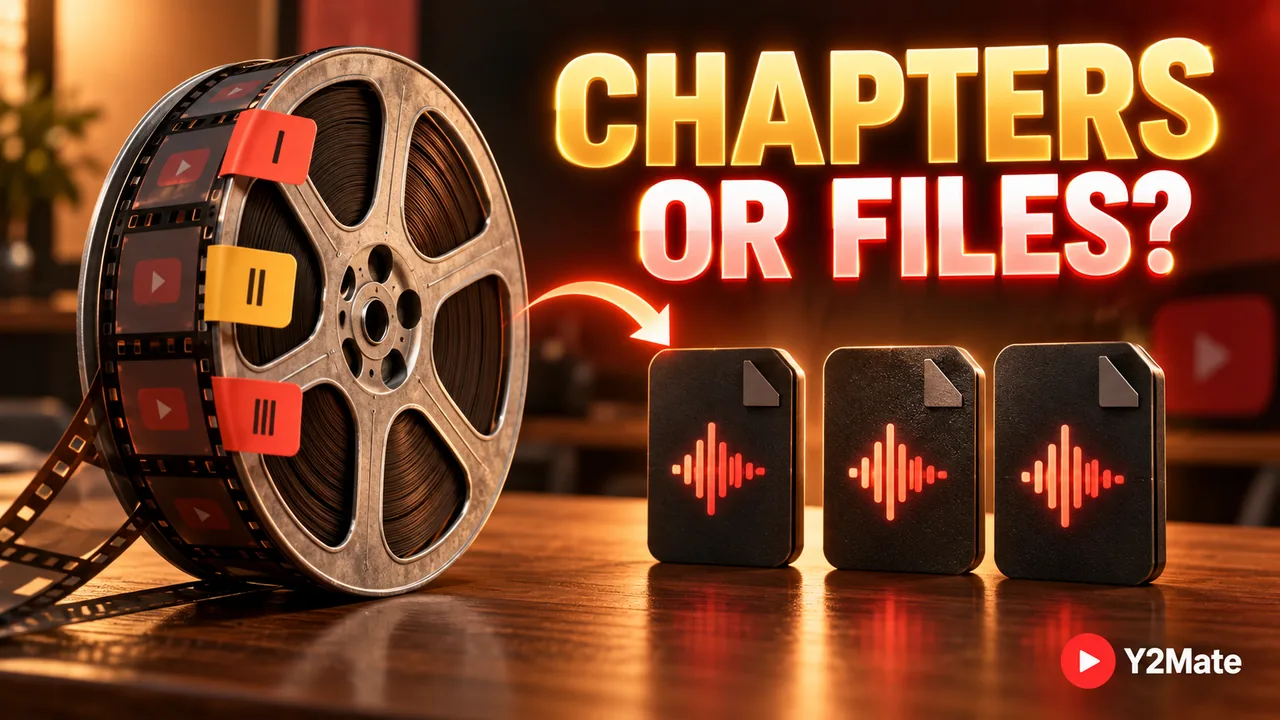
Do YouTube Chapters Become Separate Audio Files?
YouTube chapters help you move around a video, but they do not automatically make each section a separate audio file. A recording with Introduction, Demonstration, and Questions chapters may still produce one continuous download. When using Y2Mate, inspect the available result rather than expecting the chapter list to become an album of individual MP3s.
This is particularly important for lectures, interviews, long tutorials, and compilations. Their chapter names describe positions inside a source. They can be useful editing notes, but they are not proof that a download service can split, name, or package those sections for you.
A navigation marker is not a separate recording
A chapter combines a time position with a label. The creator may supply the chapter information, or the platform may generate chapters where supported. Clicking one changes the point being played within the existing video. It does not necessarily load a different upload with its own independent video identity.
Suppose your own thirty-minute workshop contains Preparation at 0:00, Assembly at 8:15, and Questions at 22:40. These labels make it easy for a viewer to reach the right section. The underlying workshop can nevertheless remain one continuous stream with speech, background sound, and transitions crossing the named boundaries.
A saved file may not retain the source player's chapter navigation. Even when a media format can carry chapter information, that does not mean a particular provider has copied it into the output. Open the completed file and inspect the features actually present in your player instead of assuming the website's navigation travels with it.
Decide whether you need splitting at all
One full recording can be easier to maintain than many short files. It preserves context, keeps the order clear, and avoids managing duplicate introductions or endings. If you only want to revisit a few moments, a short note with chapter names and times may be sufficient while keeping the complete authorized file.
Separate files make more sense when you have a specific permitted use for each segment: for example, organizing your own training recordings by exercise. Before editing, decide whether every section needs its own file or whether you only need one excerpt. The article on timestamp links and full downloads explains why sharing a moment is different from exporting that excerpt.
- Keep one file when the sections depend on each other or the discussion flows continuously.
- Record chapter times when navigation is the only problem you need to solve.
- Consider separate copies when each segment has a clear, authorized purpose.
- Do not assume a playlist, chapter list, and batch download are the same feature.
Plan boundaries before editing
Chapter times are useful starting points, not always perfect edit points. A speaker can finish an instruction just after the next chapter begins. Music may continue across a label. Cutting precisely at every marker without listening can remove context or create an abrupt beginning.
For an owned workshop, write down the section name, approximate start, approximate end, and intended output filename. Then listen around each boundary. Leave enough space for a complete phrase, and avoid placing a cut in the middle of a word or a loud sound. The goal is a useful section, not a mathematically tidy list of durations.
Keep the full original somewhere clearly separate from working copies. If you later discover that an explanation was cut too early, you can return to the source without repeating the download or trying to join already compressed fragments. Naming the original and the edited versions distinctly also reduces accidental overwriting.
Use an editor for the actual split
A local audio editor can select a region and export an authorized excerpt. That task is separate from obtaining the source file. Do not look for an automatic chapter-splitting control in Y2Mate unless such a feature is explicitly present in the interface; this article does not establish one.
The walkthrough for trimming an MP3 copy in Audacity covers a single retained selection. Repeat an editing workflow deliberately if you need more than one section, and distinguish a saved editing project from the audio files you intend to play. Exporting an MP3 may involve another encode, so avoid repeatedly exporting the same section while experimenting.
For video material, remember that removing the picture may discard essential diagrams or demonstrations. Compare formats for music, podcasts, and tutorials before assuming that every chapter is useful as audio alone.
Verify the set as a listener
After exporting, play the beginning and end of each new file and confirm the order. Check for missing words, duplicated material, and titles that describe the wrong section. If the sections are meant to stand alone, each should contain enough context for a listener who has not just heard the preceding file.
Finally, retain the permissions and source notes that belong to the recording. Creating smaller files does not create new rights to distribute them. Chapters are a convenient map of a video; thoughtful selection, editing, and verification are what turn authorized portions into useful separate media.